
 *Human Written Content
Transportation shapes access to nearly every part of daily life, from work to food, to essential travel.
Behind every route, stop, and schedule is a system that most riders never think about until something goes wrong. When that network is overlooked, the effects reach beyond those who rely on it. Not only are riders inconvenienced, but the vehicles themselves face heavier maintenance demands, shorter service life, and a greater operational strain.
For mass transit providers expanding service, the challenge isn’t just adding routes; it’s supporting the vehicles that make that service possible.
Planning additional transit services should consider all restrictions, including vehicle maintenance capacity.
While these transportation facilities should be close to service areas, they are the hardest pieces of infrastructure to site and approve.
Transit planning often separates what riders see from what keeps the system running. Routes and frequency lead the conversation. Bus depots, storage yards, and maintenance garages do not.
Guidance from the Federal Transit Administration mandates that transit service planning must coincide with capital infrastructure, including fleet storage and maintenance capacity. Buses require space for overnight storage, inspections, preventative maintenance and repair.
The ratio of vehicles per maintenance bay depends on service hours and miles and other factors, but in most cases, at least one bay for every 15 vehicles is recommended. Facilities also need sufficient room for storage of parts, fluids, tires, and other supplies. Areas for employee training, rest breaks and parking must be included.
Without this capacity, service cannot expand reliably.
Industry reports from the American Public Transportation Association point to growing pressure on transit operators to expand service while managing aging infrastructure and increasing fleet demands.
At the same time, building or expanding a bus maintenance garage introduces a different set of challenges. These sites require large parcels of land near service areas, access for large vehicle movement, and space for circulation, fueling, or charging. In dense communities, that kind of space is limited.
Even when the site is identified, approvals are not guaranteed.
Environmental review requirements under the National Environmental Policy Act require agencies to evaluate impacts such as traffic, noise, and air quality, and to engage the public in the decision-making process. This can often extend project timelines significantly, especially in developed areas where community concerns are high.
Service plans can move forward in months, while a new or expanded bus depot can take years.
In addition, the shift to electric fleets raises the stakes.
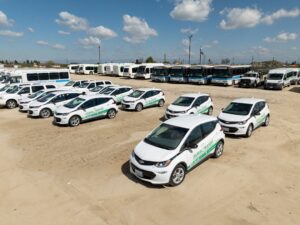
At Walker Consultants, our team has worked closely with the Fresno County Rural Transit Agency (FCRTA), to support the areas within the County lacking reliable transit access. We performed various studies and plans focusing on the implementation of fleet electrification and multimodal community resiliency hubs.
These studies evaluated what it would take for local energy grids to support a transition to zero-emission transit fleets, while exploring opportunities to capture and store energy, offset charging costs, and reduce long-term dependence on the electrical grid.
As part of that effort, resiliency hubs were designed to store and deliver backup power during emergencies, helping communities maintain access to vital services such as communication, heating and cooling, device charging, emergency coordination, and essential medical support.
Beyond cost and sustainability, these plans examined how transit systems would perform under real-world operating demands. For smaller, underserved communities across Fresno County, that means access to more reliable, cost-conscious transportation options built for long-term service.
When introducing EV transit services, maintenance areas are essential to sustaining a functionally balanced system.
Research from the National Renewable Energy Laboratory shows that electric bus depots frequently require additional space for charging infrastructure, changes to site layout and clearances, and substantial power upgrades. Existing diesel bus garages regularly need significant modifications to support these systems.
This limits where transit operators can expand and increases pressure to find new sites near existing routes.
The result is a disconnect.
A transit operator can approve more services, purchase additional buses, and secure funding, but without a nearby bus depot or maintenance garage with sufficient capacity, transit services will not match its potential.
Buses travel farther before starting service.
They cost more to operate.
They can break down more often, resulting in unreliable service.
Overcoming maintenance constraints
Transit expansion doesn’t stall because of lack of demand. It stalls when support systems are not planned at the same time.
Guidance from the Federal Transit Administration supports coordinated planning across service, fleet, and infrastructure.
Transit operators that avoid delays don’t just plan new routes. They ask:
- Where will these buses be stored?
- Which maintenance garage supports them?
- Do we need to expand the existing depot or build a new one?
This alignment prevents last-minute constraints.
New sites are difficult to approve, so many operators start with what they already own.
Common approaches:
- Reconfiguring existing bus yards to increase capacity
- Expanding maintenance garages where zoning allows
- Using temporary or satellite storage lots for overflow fleets
The American Public Transportation Association highlights how agencies extend the life and capacity of existing assets before pursuing new construction.
Bus depots are generally resisted at the neighborhood level.
Under the National Environmental Policy Act, projects must evaluate and disclose impacts, but early and consistent community engagement can reduce delays and improve project outcomes.
Planning for additional service means planning for where those buses live, not just where they run.
For help planning your next transit project, visit www.walkerconsultants.com.
*This article was written by a human and reviewed by a Walker Consultants expert